05.11.2026
The Investment Case for Ultra-Remote Island Hospitality in Southeast Asia
The global luxury hospitality market is undergoing a structural realignment. Data highlights that while luxury resort properties command an average price-per-key of $387,800, sharply escalating to over $1.2 million per key in ultra-exclusive sub-markets like the Maldives, they deliver superior long-term yields when built around isolated exclusivity. In Southeast Asia, institutional investors, private equity funds, and luxury developers are moving beyond saturated urban corridors to acquire and master-plan ultra-remote island destinations.
The primary business case for ultra-remote resort development focuses on three core pillars: pricing power driven by spatial scarcity, gross operating margin protection via decentralized off-grid infrastructure, and the strategic mitigation of isolated operational risks.
The primary business case for ultra-remote resort development focuses on three core pillars: pricing power driven by spatial scarcity, gross operating margin protection via decentralized off-grid infrastructure, and the strategic mitigation of isolated operational risks.
The Premium Yield of Spatial Scarcity
In luxury hospitality, absolute geographic isolation creates natural exclusivity and physical volume constraints. Urban upscale properties operate in hyper-competitive, high-supply environments where Average Daily Rate (ADR) increases are capped by nearby alternatives. Remote micro-resorts leverage absolute geographic barriers to create an inelastic demand curve among Ultra-High-Net-Worth Individuals (UHNWIs).
Gross Operating Profit Realities
According to regional industry benchmarks, luxury tier resorts in Southeast Asia yield a stable Gross Operating Profit (GOP) per room ranging from $90,000 to $130,000 annually, consistently outperforming upscale mainland products. The scarcity of physical keys combined with high demand for privacy drives elevated base room rates that remain resilient across macroeconomic cycles.
Ancillary Revenue Monopolization
Captive guest ecosystems allow operators to capture 100% of wallet share across Food and Beverage (F&B), wellness, ocean excursions, and private transit, such as charter seaplanes or speedboats. Ancillary spend at remote island destinations frequently represents 35% to 45% of total folio revenue, compared to less than 20% in urban hotels where guests routinely dine and seek entertainment externally.
Asset Valuation Resilience
Prime, restricted-land remote resort developments routinely realize a 10% to 20% capital appreciation within their first five years of stabilization. This physical scarcity provides institutional portfolios with a defensive buffer against traditional commercial real estate volatility.
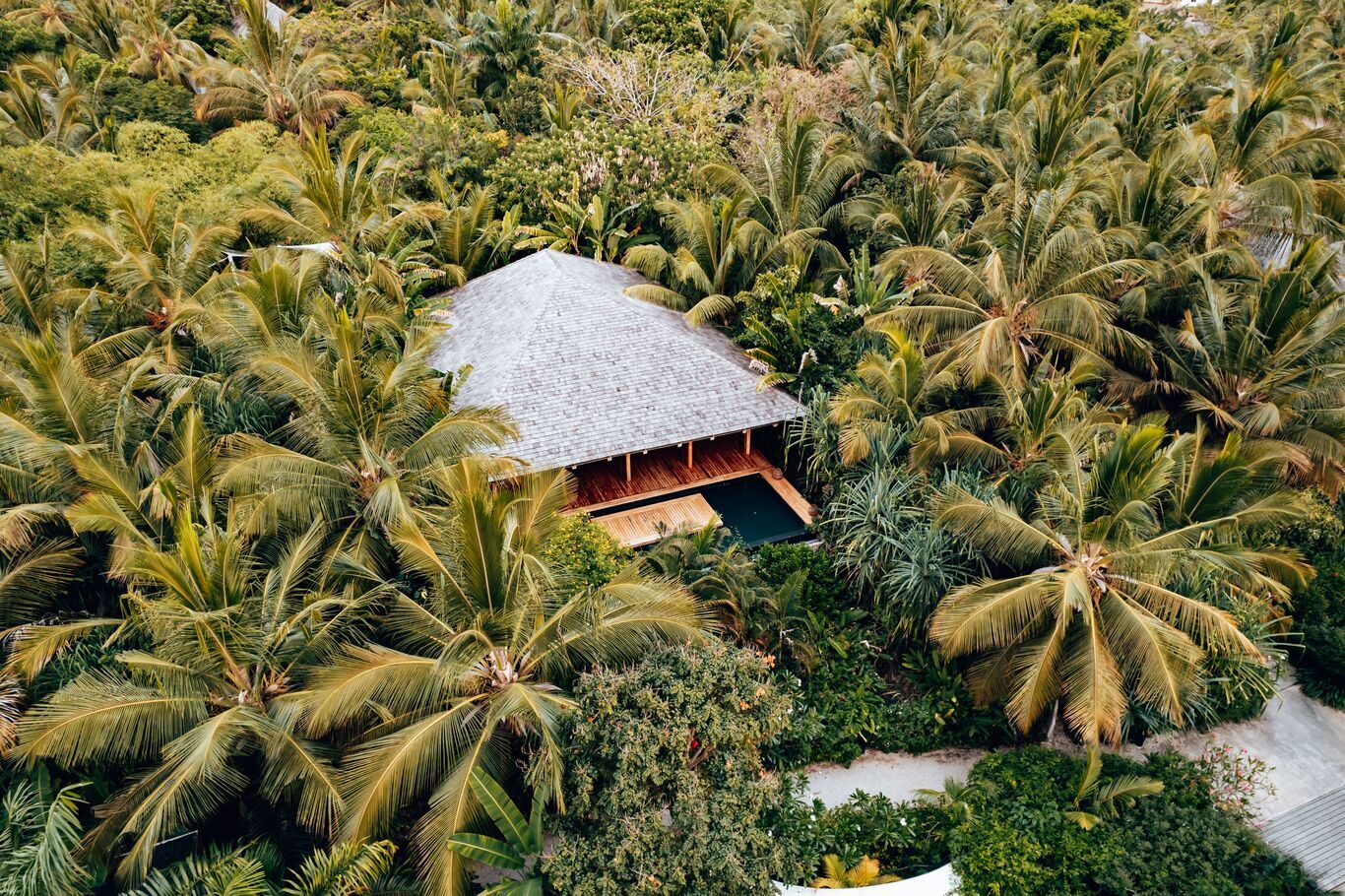
The CapEx-OpEx Reversal: Infrastructure as a Margin Shield
Developing a remote resort requires substantial upfront capital expenditure. Historically, greenfield island projects suffered from compressed returns due to complex supply chains and specialized modular construction. Modern investment models show that high upfront CapEx in sustainable, decentralized utilities acts as a direct long-term shield for Gross Operating Profit Margins (GOPM).
Pioneer properties navigate remote operational realities by deploying self-contained infrastructure models:
Properties utilizing this integrated approach maintain net profit margins between 15% and 22%, even during broader macroeconomic headwinds.
Pioneer properties navigate remote operational realities by deploying self-contained infrastructure models:
- Energy Generation: By investing heavily in solar photovoltaic arrays, microgrids, and battery storage matrices during the development phase, operators eliminate exposure to mainland grid failures and high fuel freight tariffs, locking in predictable baseline utility costs for decades.
- Water Self-Sufficiency: Deploying on-site reverse osmosis desalination plants and rainwater harvesting networks removes ongoing supply chain dependencies and eliminates the substantial OpEx associated with importing bulk bottled water.
- Supply Sourcing: Establishing on-island permaculture farms and direct partnerships with local artisanal fisheries insulates F&B operating margins from global supply chain shocks and import inflation.
Properties utilizing this integrated approach maintain net profit margins between 15% and 22%, even during broader macroeconomic headwinds.
Evolving Luxury Demographics and High-Yield Demand Profiles
The ultra-luxury hospitality market is experiencing a significant shift in guest composition. Driven by an unprecedented $84 trillion intergenerational wealth transfer and a post-pandemic realignment of consumer values, the metrics defining how ADR and Revenue Per Available Room (RevPAR) are changing. Today's premium travelers do not just pay for opulent finishes; they pay for scarcity, absolute privacy, and emotional resonance.
Four distinct demographic profiles drive high-yield demand for remote island assets:
Next-Gen HNWIs and UHNWIs (Millennials & Gen Z)
Next-generation High-Net-Worth Individualsare capturing a dominant share of discretionary luxury travel spending. Younger affluent cohorts prioritize experiential luxury over material goods. Over 38% of next-gen HNWIs explicitly indicate a willingness to pay a 30% to 50% premium for eco-certified accommodations and highly remote locations that offer low guest density and minimal crowd exposure. Rather than focusing solely on gold-leaf standard luxury, these guests demand unreplicable, hyper-local experiences. Remote resorts capitalize on this by packaging baseline villas with custom add-ons, such as private marine conservation expeditions.
"Inheritourism" and Multigenerational Anchors
A major trend shaping remote hospitality is the rise of structured multigenerational travel funded by ultra-wealthy patriarchs and matriarchs.High-net-worth grandparents increasingly fund large-scale family travel to secure a captive audience with their families in private settings. Average trip spending in this segment has expanded significantly, moving from historical baselines of $30,000 to $40,000 up to $100,000 to $150,000 per booking. This cohort frequently bypasses standard suites in favor of reserving fully staffed multi-villa compounds or complete island buyouts.
The Longevity and Bio-Hacking Cohort
Wellness travel has transformed from a secondary resort amenity into a primary driver of destination selection. Over 36% of global luxury travelers construct their itineraries around health optimization and physical restoration. Seeking to escape urban digital fatigue, these guests seek out dedicated long-stay options centered on sleep therapies, cellular detox programs, and diagnostic medical wellness. Longevity travelers exhibit high length-of-stay metrics, often booking for 7 to 14 days, delivering high margin predictability through multi-day wellness packages.
Corporate "Deep Work" and Mastermind Retreats
The evolution of corporate leadership dynamics has generated a distinct business-to-business sub-segment focused on executive retreats. C-suite executives, board members, and venture capital partners utilize ultra-remote destinations to conduct intensive strategic planning sessions away from public venues and digital distractions. These corporate bookings typically manifest as full-property buyouts during shoulder seasons, providing predictable revenue streams across F&B, private charters, and audio-visual setups while effectively smoothing out annual seasonal troughs.
Operational Models in Action
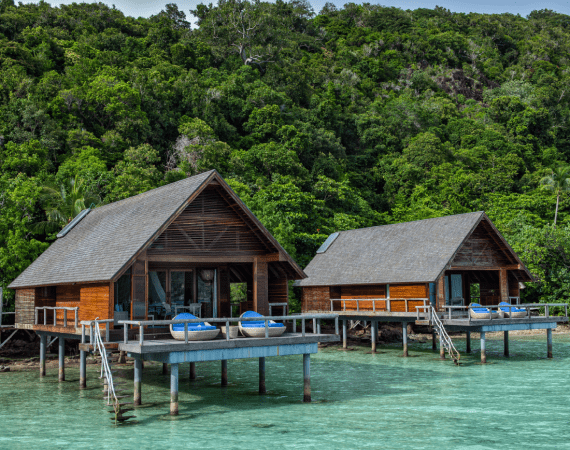
Bawah Reserve (Anambas Islands, Indonesia)
Located in a remote sub-district of Indonesia’s Riau Archipelago, Bawah Reserve spans six private islands, three lagoons, and 13 beaches. Accessible primarily via a 75-minute private seaplane charter from Singapore, it serves as a benchmark for managing extreme operational isolation.
An integrated large-scale solar array system completed in October 2022 acts as the primary electricity source, restricting diesel generators to backup utility and eliminating vulnerable fuel freight sea routes. On-site reverse osmosis microfiltration plants and gravity-fed bottling systems distill rainwater and seawater natively, eliminating approximately 1,000 plastic mineral bottles per month along with heavy freight costs. Additionally, the resort funds regional marine protection and local talent cultivation through the Anambas Foundation, mitigating talent acquisition risks by building a loyal local hospitality pipeline.
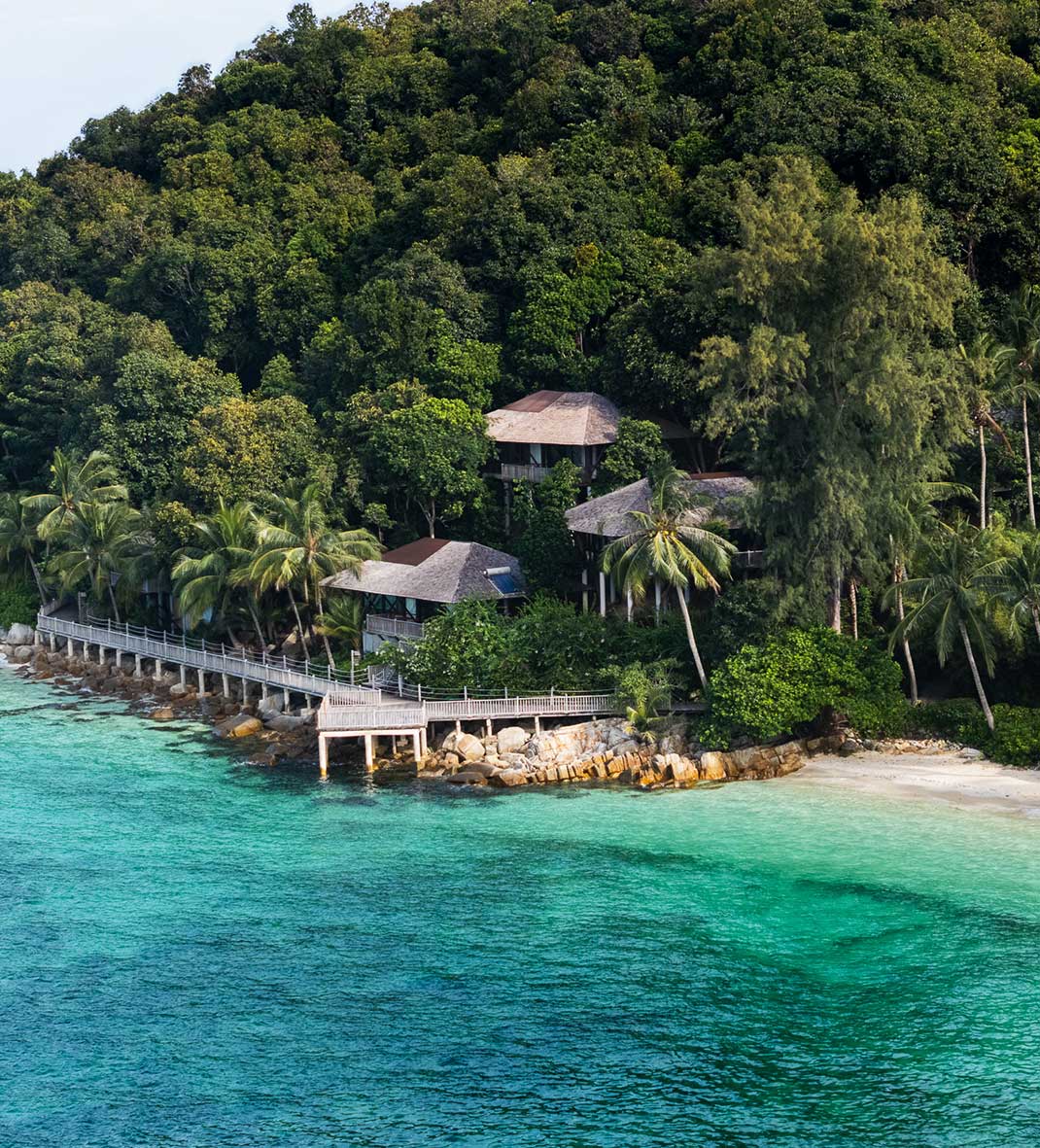
Batu Batu(Tengah Island, Johor, Malaysia)
Batu Batu Resort is an eco-luxury island development located on uninhabited Tengah Island within the protected Johor Marine Park. It operates as a model for minimizing the long-term logistical costs associated with remote properties.
Instead of relying on long supply chains from mainland Malaysia, Batu Batu utilizes local circular frameworks to protect its operating margins. Partnering with regional agricultural entities, the resort funnels 100% of its organic food waste into a closed-loop composting network. This practice eliminates the high logistics fees associated with off-island waste haulage while providing organic fertilizer for on-island landscaping. Furthermore, through the Tengah Island Conservation initiative, the resort funds regional marine monitoring, building a localized talent pool that reduces reliance on high-cost expatriate staffing.
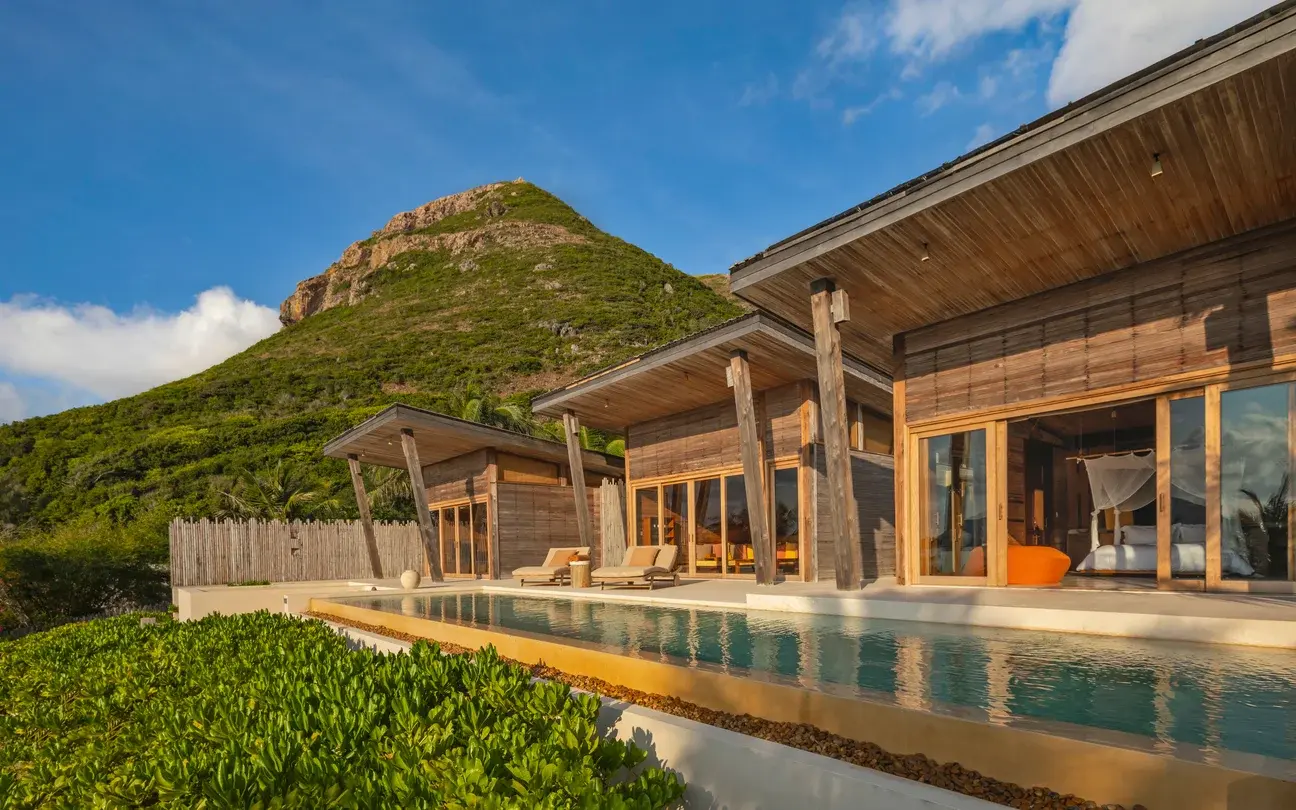
Six Senses Con Dao (Con Dao Island, Vietnam)
Developed by Indochina Land inside a highly protected National and Marine Park in Vietnam, the 50-villa Six Senses Con Dao serves as the regional benchmark for remote modular construction engineering and bioclimatic design.
Building inside a delicate marine park limits heavy on-site masonry. The structural architects designed the resort around prefabricated certified timber modules built entirely on the Vietnamese mainland. These modules were transported across the South China Sea via specialized industrial barges and dry-assembled on-site, cutting raw construction waste and localized labor premiums by over 30%.
The resort employs a unique butterfly-roof structural architecture that creates natural wind funnels. By prioritizing open-air living spaces and restricting energy-intensive air conditioning strictly to the enclosed nighttime quarters, the property reduces its baseline grid electricity dependencies by 25% relative to traditional concrete resort footprints.
The commercial viability of ultra-remote island resorts in Southeast Asia has evolved from a niche passion play into an institutional asset class. By converting geographic isolation into pricing power and leveraging off-grid utility infrastructure to compress ongoing operational expenses, developers can capture high-yield demand from next-generation HNWIs, multigenerational families, and corporate groups. As capital markets continue to value scarcity and margin protection, remote island hospitality stands out as a high-performing investment frontier in Southeast Asia.
